
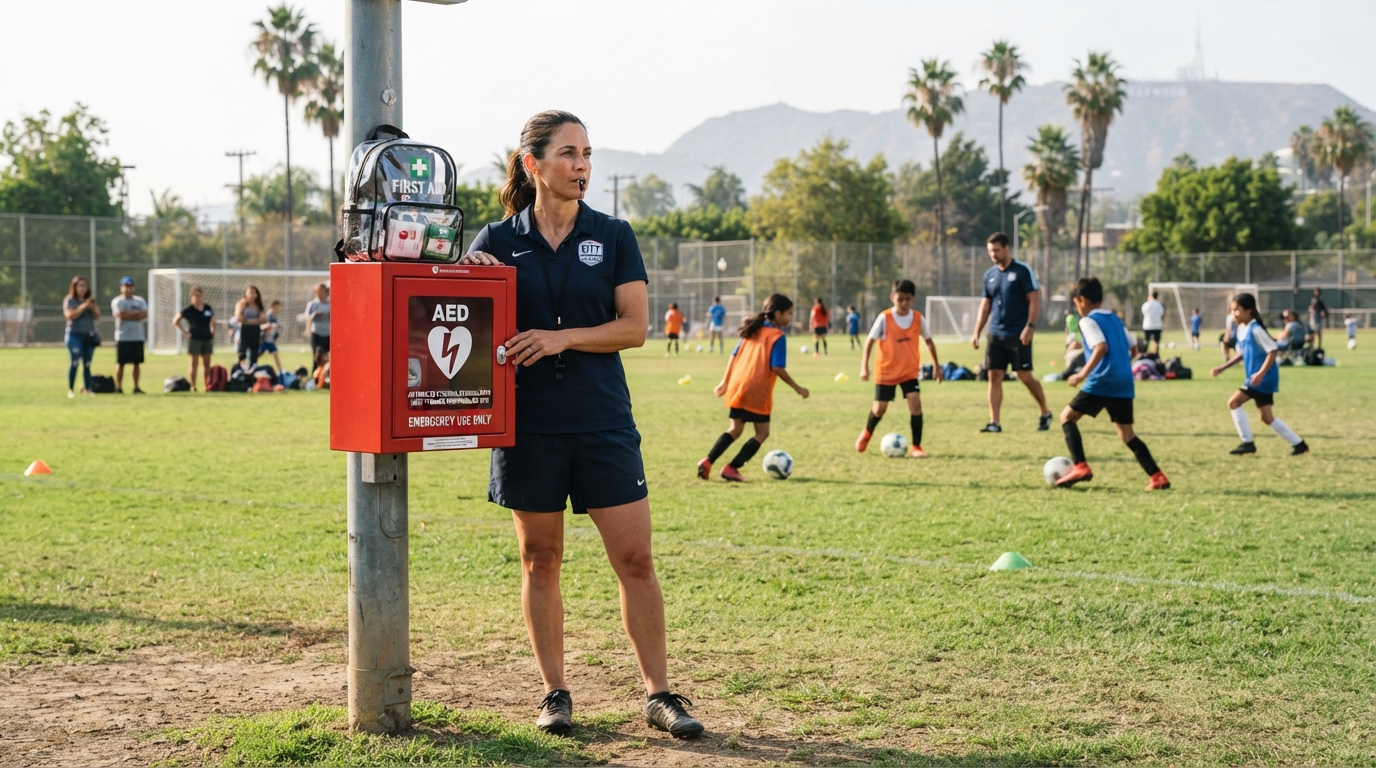
California’s youth sports AED law is changing, and Los Angeles families, coaches, leagues, and sports facilities should understand the new requirements before they take effect. Governor Gavin Newsom signed Assembly Bill 387, known as the Nevaeh Youth Sports Safety Act, on September 27, 2026.
The law focuses on access to automated external defibrillators, or AEDs, during organized youth sports activities. It also builds on existing requirements for coach training and written cardiac emergency response plans.
The changes arrive in stages. Beginning January 1, 2027, youth sports organizations must meet coach CPR and AED certification requirements and maintain a written cardiac emergency response plan. Additional AED access, maintenance, and facility coordination requirements become operative on January 1, 2028.
For parents, the law provides another reason to ask where emergency equipment is located and how coaches will respond if a young athlete suffers sudden cardiac arrest. For organizations and facilities, it creates more specific preparation and coordination duties.
However, AB 387 should not be read as automatically creating civil liability whenever a medical emergency occurs. The law contains important limitations and expressly preserves certain existing immunity rules.
How the Youth Sports AED Law Changes California Safety Requirements
California’s Nevaeh Youth Sports Safety Act applies to qualifying youth sports organizations that conduct amateur sports involving participants age 17 or younger.
The rules are not limited to one sport. Depending on the organization and setting, they may affect activities such as soccer, basketball, baseball, football, volleyball, swimming, martial arts, and other organized youth programs.
The goal is to improve emergency readiness when sudden cardiac arrest occurs during an official practice or match.
Coach Training and Emergency Plans Become Important in 2027
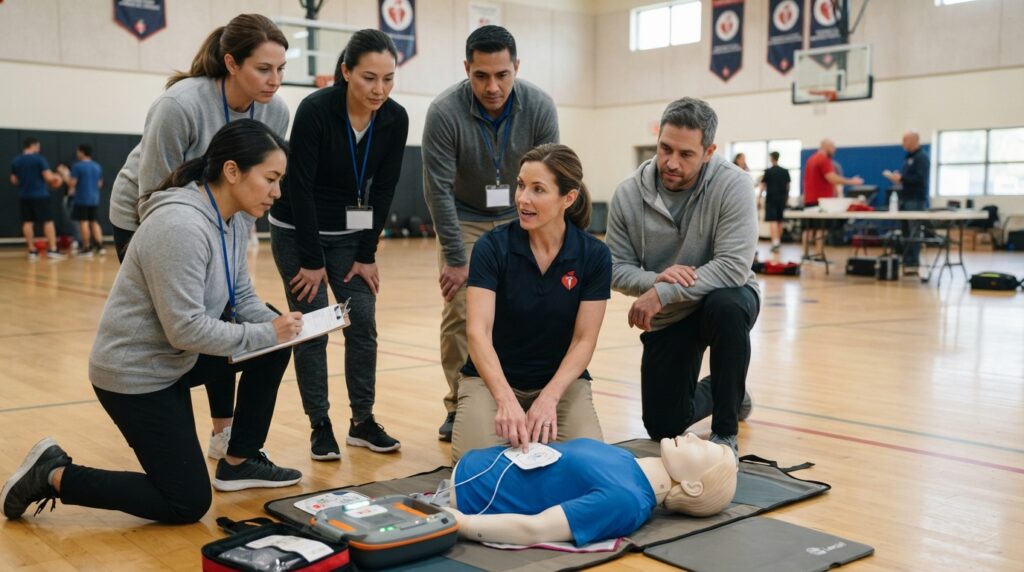
Beginning January 1, 2027, a youth sports organization must ensure that its coaches are certified to perform cardiopulmonary resuscitation and operate an AED.
Coaches must be recertified at least every two years. The training may occur in person or online, but it must come from an accredited organization and follow recognized cardiovascular care standards.
The organization must also maintain a written cardiac emergency response plan.
That plan is not supposed to remain forgotten in a binder. The law requires organizations to review it annually with coaches and staff.
The Emergency Plan Must Include Specific Information
The written plan must identify the location of available AEDs and describe what should happen during a suspected sudden cardiac arrest.
It must also explain the responsibilities of coaches, administrators, and athletes during an emergency. The organization should establish how those people will be notified and trained on the plan.
Parents and guardians also become part of the communication process. The law requires an annual electronic communication that provides the plan, or a link to it, along with AED locations and the staff members designated to be contacted during a sudden cardiac event.
For families, this creates an opportunity to ask practical questions before an emergency occurs. Where is the AED? Is it accessible during an evening practice? Who knows how to use it? Who calls emergency medical services?
AED Access Requirements Expand in 2028
Beginning January 1, 2028, youth sports organizations must ensure that athletes have access to an operational AED during official practices and matches.
AB 387 adds more detail about how that access works when activities take place at a public or private local facility with permanent sports infrastructure.
If the facility has procured and maintains an AED, it must make the device accessible to the youth sports organization during the permitted practice or match.
If an AED is not available at the location, the youth sports organization must ensure that an operational device is available during the entire activity.
The legislation also addresses local educational agencies. When an AED is considered available at a school facility, its location must satisfy accessibility conditions described in the law, such as being in the same common area, field, or another reasonably accessible location.
This new framework encourages leagues and facilities to plan together instead of waiting until an emergency to determine who controls the equipment.
Sports Facilities and Youth Organizations Will Need to Coordinate
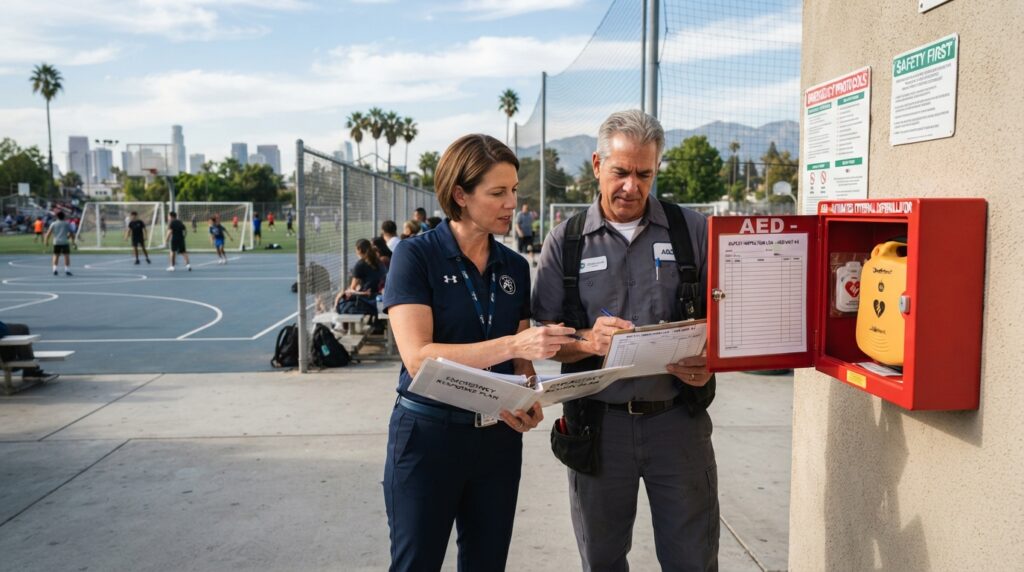
AB 387 specifically requires collaboration between qualifying public or private local facilities and youth sports organizations when an AED has been installed.
The facility and organization must work together to make sure the device can actually be accessed during practices and matches.
They may also identify ways to share costs connected with installing, maintaining, or making the AED accessible.
This matters in Los Angeles because youth sports often take place at facilities that serve many separate organizations. A soccer league might rent a field from one entity while another club uses the same property later that day.
A device located behind a locked office door may provide little practical protection if no one can reach it when the field is being used.
AB 387 Does Not Automatically Create Liability After Every Emergency
The law includes important legal limitations. AB 387 states that it should not be interpreted as requiring a public or private local facility or its employees to purchase or install an AED in every situation.
It also does not require facility employees themselves to operate or administer the AED during a suspected cardiac emergency.
In addition, the law says its requirements do not create a mandatory duty under California Government Code Section 815.6 and do not eliminate immunities that may otherwise apply.
That language is important in a personal injury analysis.
A violation of a safety requirement can be relevant evidence in some disputes, but it does not mean every medical emergency automatically becomes a successful negligence claim. Liability depends on the applicable law and the facts surrounding the incident.
Readers who want a broader introduction can review our guide to Los Angeles personal injury claims and common legal questions.
What Families Should Document After a Serious Youth Sports Emergency
When a child suffers a serious injury or medical emergency during organized sports, obtaining emergency medical care comes first.
After the immediate situation is under control, parents may need to understand exactly what happened. Memories can fade quickly, and equipment or facility conditions may change before anyone begins a formal investigation.
Good documentation can help establish the timeline without forcing anyone to rely entirely on memory.
Preserve Emergency Plans, Witness Information, and Facility Records
Start with the basic facts. Record the date, time, facility, team, coaches, and activity taking place when the emergency occurred.
Identify witnesses who saw the athlete collapse or observed the emergency response. Their accounts may help establish when symptoms became visible, when CPR began, when emergency services were contacted, and whether an AED was available.
Parents may also request or preserve relevant communications from the youth sports organization. These can include registration materials, safety policies, coach information, emails, emergency plans, and notices concerning AED locations.
Photographs of the facility can provide useful context. Document the field or court, exits, emergency equipment locations, signage, and access points when appropriate.
Do not interfere with medical equipment or emergency personnel simply to collect evidence.
The Timeline Can Matter More Than Assumptions About Fault
A careful investigation should establish what actually happened rather than begin with an assumption that one person must be responsible.
Important questions may include when the athlete first showed signs of distress, who recognized the emergency, whether CPR began, where the nearest AED was located, whether it could be accessed, and when paramedics arrived.
Medical records can help document the child’s condition and treatment. Facility records may show AED maintenance or inspection history when that equipment becomes relevant.
If there is a dispute about responsibility, California’s broader negligence principles can also matter. Our article on comparative negligence in California personal injury cases explains how responsibility can be evaluated when several parties or actions contributed to an injury.
Parents should also preserve medical bills, insurance records, school absence records, rehabilitation information, and documents showing any ongoing effects of the event.
When a serious injury leads to an insurance claim, organized documentation can help explain both what happened and how the child’s recovery has progressed. Our guide to navigating a personal injury claim in Los Angeles provides a broader overview of evidence, medical care, and claim preparation.
The youth sports AED law gives Los Angeles families an additional safety framework to understand as 2027 and 2028 approach.
The first major deadline arrives January 1, 2027. Youth sports organizations must ensure that coaches receive CPR and AED certification, maintain that certification, and work from a written cardiac emergency response plan.
youth sports AED law
The AED access provisions become operative January 1, 2028. At that point, youth sports organizations and facilities with permanent sports infrastructure will have additional responsibilities concerning AED availability, maintenance, accessibility, and coordination.
The law does not guarantee that every cardiac emergency can be prevented. It also does not automatically establish civil liability whenever an athlete becomes injured or a facility fails to meet one element of the statute.
Instead, it creates a clearer system for emergency preparation before children step onto the field or court.
For parents, some of the most useful questions are simple. Does the organization have a cardiac emergency plan? Are the coaches trained? Where is the AED? Can someone reach it quickly during practice? Does the organization know who is responsible for calling 911 and beginning the emergency response?
Those questions can help turn a written safety policy into a practical plan.
Readers can review the enacted legislation through the California Legislature’s official AB 387 page.
This article provides general educational information and does not constitute legal or medical advice. Youth sports safety requirements, negligence claims, governmental immunity, medical issues, and filing deadlines depend on the specific facts and applicable law.