
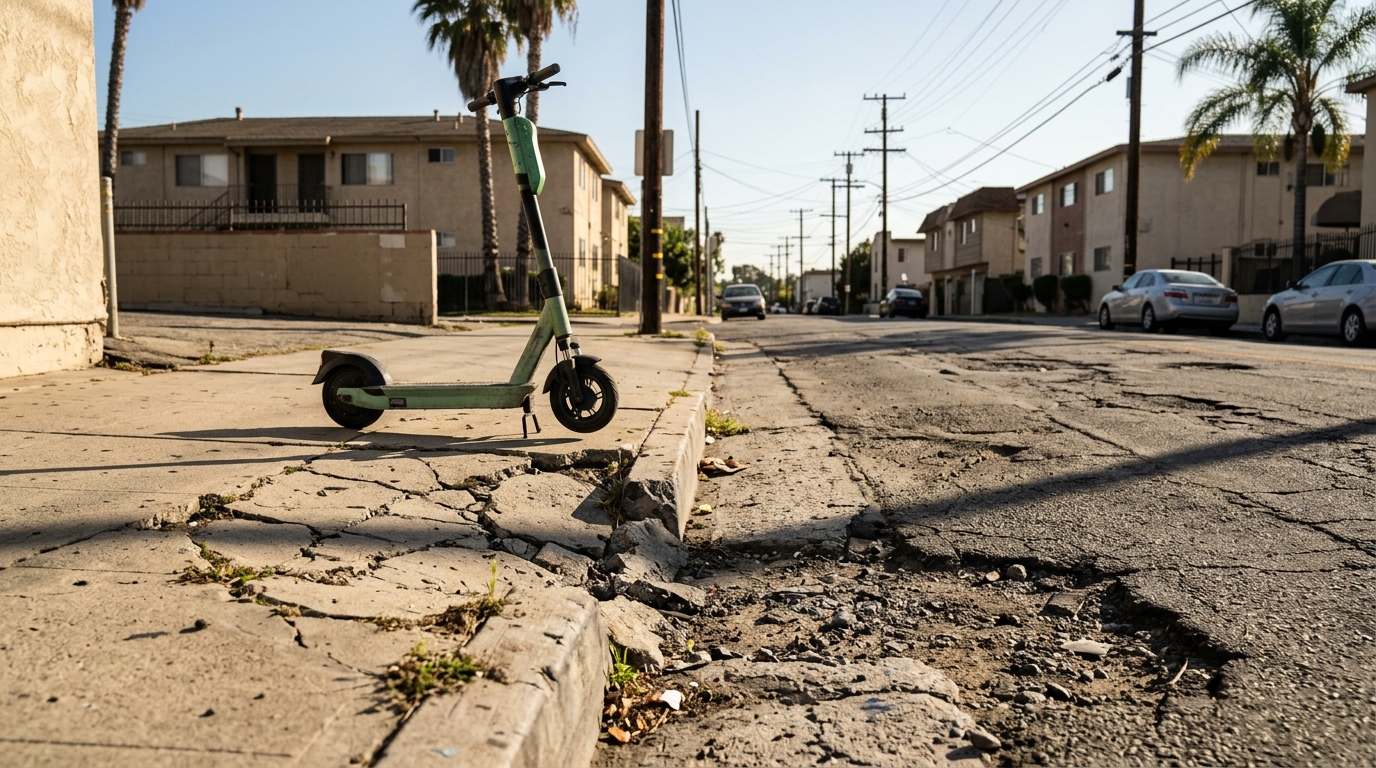
Los Angeles e-scooter injury claims in 2026 raise important questions about dangerous sidewalks, government responsibility, and the evidence needed to prove negligence. Shared electric scooters are a familiar sight across Southern California. However, a fall caused by uneven pavement or a poorly maintained walkway does not automatically establish that a city must compensate the injured rider.
On May 15, 2026, the California Court of Appeal issued a published decision in Sargenti v. City of Long Beach. The case involved a rented electric scooter, an asphalt patch, and allegations that a public roadway condition caused serious injuries.
The appellate court affirmed judgment in favor of the city because the plaintiff had not presented sufficient admissible evidence establishing actual or constructive notice of the alleged dangerous condition. The decision demonstrates why photographs, maintenance records, and authenticated historical evidence can matter in public-property injury claims.
Although the accident occurred in Long Beach, the legal principles are relevant to potential claims involving public property in Los Angeles and neighboring communities.
This guide explains the decision, California’s dangerous-condition rules, common evidence problems, and practical steps injured scooter riders should understand.
What the 2026 California E-Scooter Court Decision Means for Injury Victims
The dispute in Sargenti v. City of Long Beach arose from an accident in January 2020. The plaintiff was using a rented electric scooter when he encountered an asphalt patch while moving from a sidewalk toward a bicycle lane.
After falling and suffering injuries, he sued the City of Long Beach and an adjacent property owner. His lawsuit alleged that a dangerous condition existed and that the defendants had improperly created or maintained it.
The city disputed responsibility. Among its arguments, it asserted that there was insufficient evidence showing it had notice of the condition before the accident.
The dispute eventually reached the California Court of Appeal, where evidentiary questions became central to the outcome.
Why the city was not held liable in Sargenti v. City of Long Beach
The trial court originally granted summary judgment based on provisions in the scooter rental agreement that purported to release certain parties from liability.
The appellate court affirmed judgment for the city on a different ground: the plaintiff failed to establish a triable issue concerning the city’s actual or constructive notice of the allegedly dangerous condition.
The court examined maintenance information, interrogatory responses, and the plaintiff’s attempted use of a historical Google Street View image.
The city presented evidence that its records did not identify relevant complaints, maintenance requests, or reports concerning the asphalt patch before the accident.
The plaintiff argued that the patch had existed for years. However, the historical image offered to support that claim was not properly authenticated and could not be relied upon in the form presented.
The ruling illustrates that possessing a potentially useful image is different from establishing its admissibility in court.
Why a Google Street View screenshot was insufficient
Historical street imagery can help establish how a location appeared before an accident. A photograph from an earlier year might show that damaged pavement existed for a substantial period.
However, courts require evidence to satisfy applicable authentication and admissibility requirements.
In the Sargenti case, the plaintiff attempted to rely on a Google Street View screenshot without establishing the necessary evidentiary foundation.
The appellate court explained that merely suggesting an evidentiary defect could be corrected at trial did not make the inadmissible image sufficient to defeat summary judgment.
This does not mean Google Street View is never useful in litigation. Properly authenticated historical imagery may support a claim when the applicable evidentiary requirements are satisfied.
The important lesson is that digital evidence must be collected, preserved, and presented correctly.
Actual notice versus constructive notice of a sidewalk hazard
California Government Code Sections 835 and 835.2 govern important aspects of dangerous-condition claims involving public property.
Actual notice generally involves evidence that the public entity knew about the particular dangerous condition and knew or should have known about its hazardous character.
Constructive notice may exist when a condition was sufficiently obvious and existed long enough that the public entity, exercising due care, should have discovered it.
For example, documented complaints about a broken sidewalk may support a notice investigation. Historical inspection records or properly authenticated photographs may also be relevant.
However, not every old pavement defect proves constructive notice. Its duration, visibility, severity, location, and surrounding circumstances can all matter.
Injury victims should understand that evidence of a hazard and evidence of government notice address different legal questions.
How California law applies to dangerous sidewalks
Government Code Section 835 generally requires proof that public property was in a dangerous condition, that the condition proximately caused the injury, and that the condition created a reasonably foreseeable risk of the type of injury suffered.
The statute also requires a qualifying basis involving creation of the condition by a public employee or actual or constructive notice by the public entity.
Additional defenses may apply. A public entity might dispute ownership or control, challenge whether the condition created a substantial risk, or argue that the injured person’s conduct contributed to the accident.
The analysis must consider the specific property, the circumstances of its use, and applicable California law.
For broader injury information, readers can explore our Los Angeles personal injury resources.
Can improper scooter use affect an injury claim?

California law generally prohibits operating motorized scooters on sidewalks, subject to applicable exceptions. Riders must also follow relevant traffic and equipment rules.
Improper operation may become relevant when evaluating whether the property was being used in a reasonably foreseeable manner and whether the rider contributed to the accident.
However, violating a traffic rule does not automatically resolve every issue of government responsibility.
California’s comparative negligence principles may also affect claims involving multiple contributing causes.
Investigators should examine the rider’s speed, direction, available pathways, visibility, roadway conditions, and the location of the alleged defect.
How to Preserve Evidence After an E-Scooter Accident in Los Angeles
A serious scooter accident may leave an injured person with fractures, head injuries, spinal trauma, or other conditions requiring medical attention.
Safety and treatment must come first. When injuries are significant, emergency medical assessment may be necessary.
After the immediate danger has passed, preserving evidence can become important because road conditions may change quickly.
Maintenance crews may repair damaged pavement, remove debris, or change the surrounding area. Businesses may also overwrite surveillance recordings.
Injury victims should preserve information as early as safely possible without interfering with necessary medical treatment.
Photographs, maintenance records, and legal deadlines
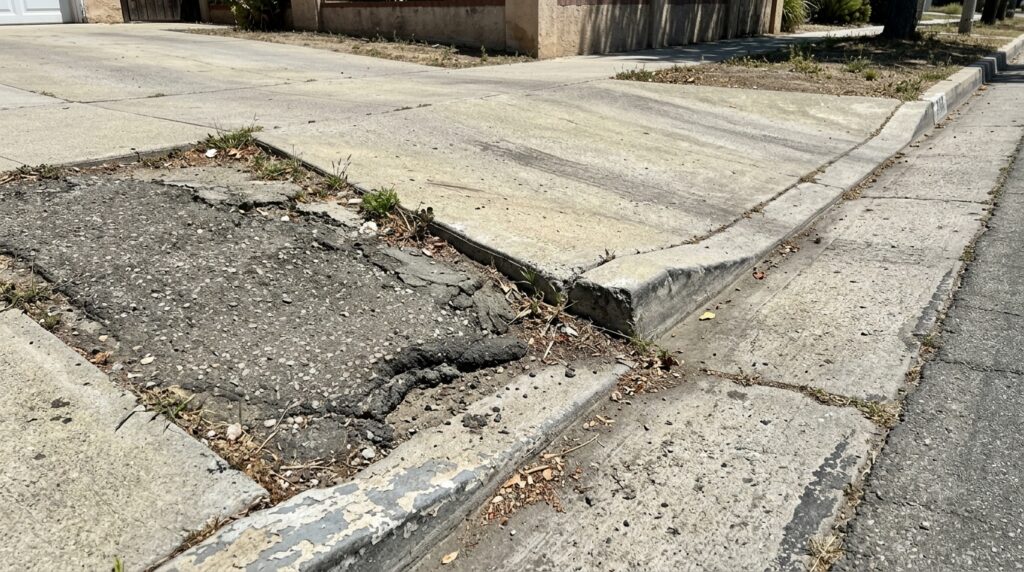
Photographs should document the alleged hazard from several perspectives. Useful images may show damaged asphalt, raised pavement edges, cracks, nearby signs, street markings, and the path the rider traveled.
Include wider photographs that establish the location and surrounding environment, not only close-ups of the defect.
Where possible, preserve original digital files and relevant metadata. Avoid altering the originals because later edits may raise questions about reliability.
Witness information can also help establish whether the condition existed before the accident and how the fall occurred.
Maintenance records, inspection logs, prior complaints, and repair requests may provide additional evidence concerning government knowledge.
The records should be evaluated together rather than assuming that any single document establishes liability.
Why government claim deadlines require immediate attention
California generally requires personal injury claims against public entities to be presented through an administrative claim process before filing many lawsuits.
Under Government Code Section 911.2, a claim relating to personal injury generally must be presented within six months after accrual.
This deadline is substantially shorter than the ordinary two-year limitations period applicable to many California personal injury lawsuits.
Additional requirements govern the claim’s contents, the proper public entity, late-claim applications, rejection notices, and subsequent lawsuits.
Because identifying the responsible entity can take time, suspected public-property claims should be evaluated promptly.
Not every sidewalk is controlled by the same government agency. Depending on the location and circumstances, responsibility may involve a municipality, another public entity, or a private party.
Legal ownership, maintenance duties, and the alleged creation of the hazard should be investigated before reaching conclusions.
Our slip-and-fall accident resources discuss related concerns involving hazardous property conditions and injury documentation.
Digital records deserve special attention. A scooter rental account may contain trip details, payment history, timestamps, and location information relevant to the incident.
These records should be preserved when available. However, GPS information may have limitations and should not automatically be treated as an exact reconstruction of the rider’s movements.
Similarly, street imagery may provide historical context but requires proper verification before it can support a legal argument.
Non-economic
Medical documentation is essential when assessing damages. Emergency records, imaging studies, treatment notes, rehabilitation records, and work restrictions can help explain the consequences of an injury.
Possible economic losses include reasonable medical expenses, lost earnings, and related financial costs.
Non-economic damages may also be available in qualifying cases, depending on the injuries, applicable law, and supporting evidence.
California’s comparative negligence system may reduce recoverable damages according to the injured person’s assigned percentage of responsibility.
That means investigators may need to distinguish the effects of a dangerous surface from the rider’s own conduct.
For example, a pavement defect could contribute to a fall while excessive speed or improper scooter operation also affects the outcome.
Importantly, insurance coverage and legal liability are separate questions. Establishing that someone contributed to an injury does not guarantee that sufficient insurance exists to cover every loss.
Victims may also encounter disagreements involving a scooter rental agreement. The enforceability of waivers depends on the language, applicable law, and nature of the legal duty involved.
The Sargenti opinion should not be summarized as establishing that every scooter rental waiver protects public entities from injury claims. The appellate decision ultimately rested on the inadequate evidence of government notice.
Readers
Readers can review the full Sargenti v. City of Long Beach appellate opinion for the court’s reasoning and procedural history.
Although this decision involved an electric scooter, its evidence principles may also matter in other public-property cases involving pedestrians, cyclists, and people injured by deteriorated pavement.
For related injury situations involving drivers who cannot immediately be identified, see our guide to Los Angeles hit-and-run accident claims in 2026.
These cases differ legally, but both illustrate why early evidence preservation can help clarify disputed facts.
The May 2026 appellate ruling is an important reminder that injury claims against public entities require more than proof that someone was hurt.
Claimants must address dangerous-condition requirements, causation, notice or creation of the condition, admissible evidence, and procedural deadlines.
For Los Angeles e-scooter injury claims in 2026, documenting the location, preserving original photographs, identifying maintenance history, and understanding government claim procedures can be especially important.
Disclaimer: This article provides general educational information and does not constitute legal advice. Individual claims depend on their facts, applicable law, and available evidence.